
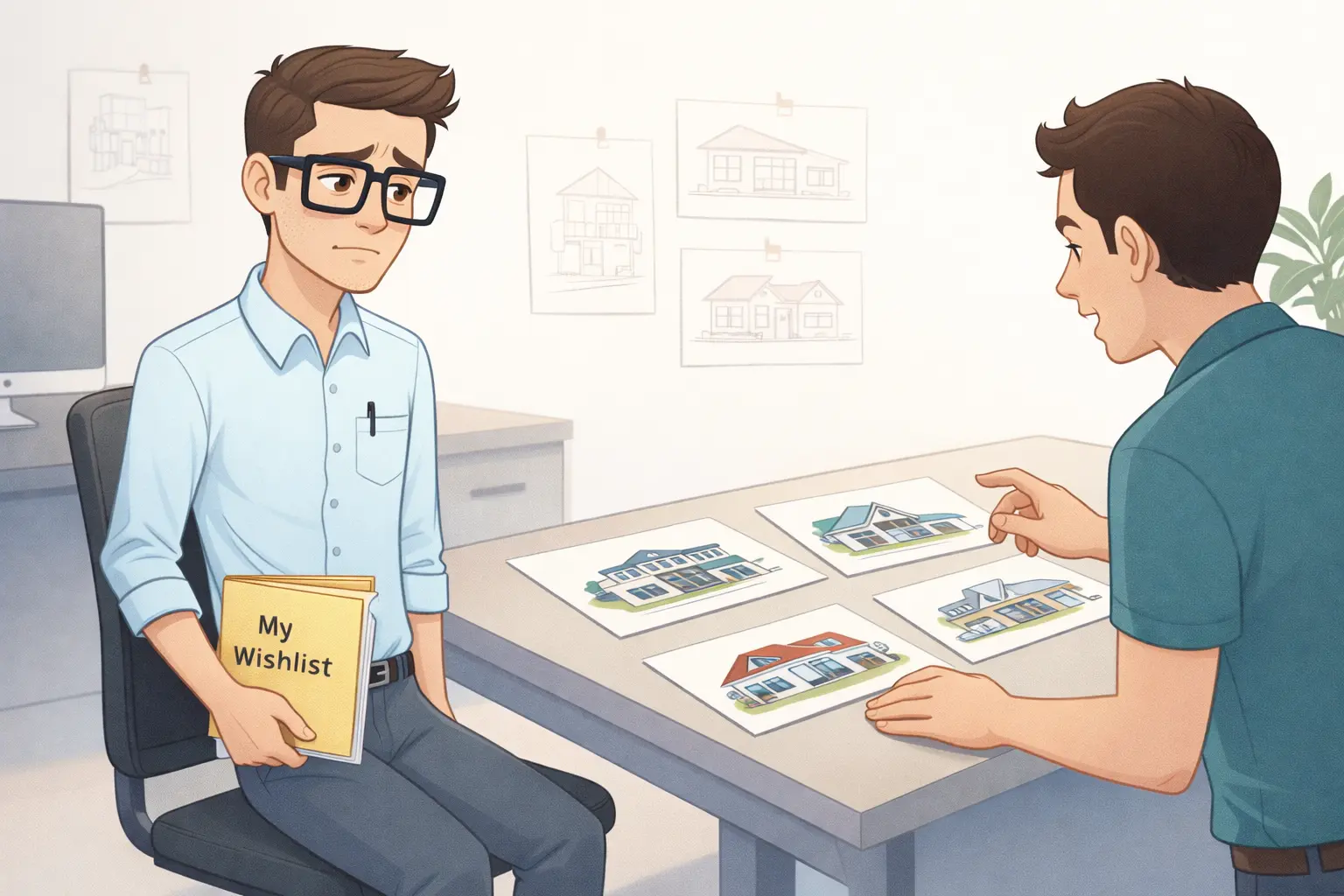
Building your dream home or workspace usually starts with excitement. Long before you meet a designer, you already have a vision. You save images, note down ideas, imagine how your mornings will feel, how light will enter your rooms, and how the space will reflect you. These ideas aren’t random — they come from your lifestyle, your habits, and your personal story.
Then comes the design presentation. It looks impressive. It follows rules. It makes sense on paper. Yet somewhere deep inside, something feels off. You struggle to explain it, but the design doesn’t feel like your home anymore. You start questioning yourself. Am I overthinking? Should I just trust the designer? Do my ideas even matter?
This is the phase no one really talks about — where homeowners feel confused, unheard, or torn between what they imagined and what is being proposed. This blog is for those who feel that quiet discomfort but don’t know how to express it. Because your ideas don’t need to be replaced — they need to be understood.
When Your Dream Starts Feeling Like Someone Else’s Idea
1. Your Wishlist Was Emotional. The Design Is Logical.
Your wishlist didn’t come from a catalogue.
It came from your life.
From how you wake up in the morning.
From how you host people.
From how much silence or openness you enjoy.
From memories, habits, routines, and aspirations.
A designer’s proposal, on the other hand, often comes from logic. It is built on rules, proportions, efficiency, and experience. It looks correct. It functions well. On paper, everything adds up.
And here’s the truth: neither is wrong.
But the gap between emotion and logic can feel uncomfortable. When lifestyle meets structure without enough conversation, the design may start feeling distant — impressive, yet unfamiliar. That gap is where discomfort begins.
2. “Maybe the Designer Knows Better…”
This is the moment self-doubt quietly enters.
You start thinking:
“They are professionals.”
“Maybe my ideas are not practical.”
“I don’t want to sound difficult.”
Slowly, homeowners begin to hold back. Preferences are softened. Questions go unasked. Opinions are adjusted to fit what feels “acceptable.” Not because the ideas disappear — but because expressing them starts feeling risky.
There is also a silent fear of being labeled unprofessional, confused, or too demanding. So instead of pushing back, many homeowners choose silence. And that silence slowly distances them from their own dream.
3. Why This Conflict Feels So Personal
Because this isn’t a product you can replace later.
This is your home.
Every decision feels permanent. Every compromise feels like it will live with you for years. You’re not choosing colors or layouts — you’re shaping the space where your life will unfold.
That’s why the stress doesn’t arrive loudly.
It builds quietly.
In small doubts.
In hesitant approvals.
In designs you accept but don’t fully connect with.
And when your dream home starts feeling like someone else’s idea, the discomfort is not about design anymore — it’s about feeling unheard.
Why Most Homeowners End Up Confused at This Stage
Confusion at this stage doesn’t mean you lack clarity. It usually means you care deeply. Most homeowners who reach this point have already spent time imagining their future space. Yet, once the process begins, clarity slowly gives way to uncertainty. Not because anyone is wrong — but because the process itself isn’t designed to translate emotion into execution smoothly. This is where even confident homeowners begin to feel unsure, torn, and overwhelmed.
1. Pinterest Dreams vs Practical Reality
Online inspiration is powerful — but incomplete.
Images don’t come with context. They don’t show plot limitations, local regulations, structural needs, climate conditions, or budget realities. What looks effortless on a screen may require heavy compromises on a real site.
The real problem isn’t that something can’t work.
It’s that no one explains why.
Without explanation, homeowners feel dismissed. A dream is rejected without reasoning, and confusion replaces confidence. When understanding is missing, acceptance feels forced — and that’s where discomfort begins.
2. Designers Speak Design. Homeowners Speak Emotion.
Designers communicate through drawings, plans, and technical terms.
Homeowners think in moments, routines, and feelings.
You imagine how your mornings flow, where conversations happen, how private or open a space feels. Designers translate ideas into measurements and layouts. Both are valid — but they are different languages.
When emotion isn’t translated into design language clearly, miscommunication becomes inevitable. The homeowner feels unheard. The designer feels misunderstood. And slowly, both start moving in different directions — even while working on the same project.
3. The Pressure to Decide Fast
Design timelines move quickly.
There are budgets to lock, approvals to take, schedules to maintain. In this rush, homeowners often say “okay” not because they’re convinced — but because they don’t want to delay the process.
Decisions made under pressure feel manageable at the moment. But regret rarely shows up immediately. It appears later — during execution — when changes become expensive, difficult, or impossible.
That’s when homeowners realize they agreed before they fully understood.
4. When You Feel Stuck in the Middle
This is the most uncomfortable place to be.
Between your heart and professional advice.
Between trust and unease.
Between the dream you imagined and the design you’re shown.
You want to trust the expert. You also want to trust yourself. When those two don’t align, doubt grows quietly. And that doubt doesn’t mean you’re confused — it means you’re searching for clarity that hasn’t been offered yet.
How to Align Your Wishlist With a Designer’s Vision (Without Conflict)
The solution is not about choosing sides. It’s not about proving who is right or whose idea is better. Most conflicts in home design don’t come from ego — they come from misalignment. When homeowners and designers begin to see the process as a shared responsibility instead of a negotiation, clarity replaces confusion. Alignment doesn’t require louder opinions; it requires better understanding. And that understanding starts with a few important shifts in how decisions are made.
1. Understand This First: It’s Not You vs the Designer
This is not a battle.
You are not trying to protect your ideas, and the designer is not trying to override them. When tension appears, it usually means the process is missing collaboration, not competence.
Design works best when both sides move in the same direction. The goal is not dominance — it is alignment. Once this mindset changes, conversations become calmer, and decisions feel shared instead of forced.
2. Translate Your Wishlist Into Priorities
Not every idea carries the same weight — and that’s okay.
Ask yourself:
- What is truly non-negotiable for my lifestyle?
- What am I open to adjusting?
- What matters emotionally, and what matters visually?
This clarity empowers you. When you communicate priorities instead of preferences, designers can respond with intention instead of assumptions. Your wishlist becomes structured, not diluted.
3. Ask the Right Questions (Not More Questions)
Clarity doesn’t come from asking more — it comes from asking better.
Instead of adding confusion, focus on understanding:
- Why is this layout suggested?
- What changes if we adjust this element?
- How does this decision affect cost, light, ventilation, and movement?
These questions shift the conversation from opinion to insight. They create understanding, not resistance.
4. Don’t Approve What You Don’t Understand
Speed feels productive, but clarity is protective.
If something doesn’t feel clear today, it will feel heavier tomorrow. Approvals made in confusion often turn into regret during execution.
A good decision feels calm. It doesn’t rush you. It doesn’t pressure you. When you truly understand a design, acceptance feels natural — not forced.
5. The Role of Guidance, Not Just Design
Design alone is not enough.
Homeowners don’t just need drawings — they need explanation. They need to understand why decisions are made and how they affect the final outcome.
The best results come when planning and execution speak the same language. When thinking is coordinated, confusion disappears. What remains is confidence — in the process and in the result.
Conclusion
Your Home Should Feel Right, Not Just Look Right
Feeling conflicted during the design journey does not mean you are confused or difficult. It means you care. It means you are paying attention to how your future space will support your life, your routines, and your sense of comfort. A home is not something you simply look at — it is something you live inside every day. Wanting it to feel right is not overthinking; it is responsibility.
The right home-building journey is not about choosing between your ideas and a professional’s advice. It is about creating clarity before commitment. When you understand the reasoning behind every decision, trust grows naturally. Doubt fades. Confidence replaces hesitation.
If you are questioning a design, you are not delaying progress — you are protecting your future. Asking for understanding, explanation, and alignment does not make you difficult. It makes you a thoughtful, responsible homeowner who values quality over speed.
Because in the end, a beautiful home is not defined by how impressive it looks — but by how deeply it feels like yours.