
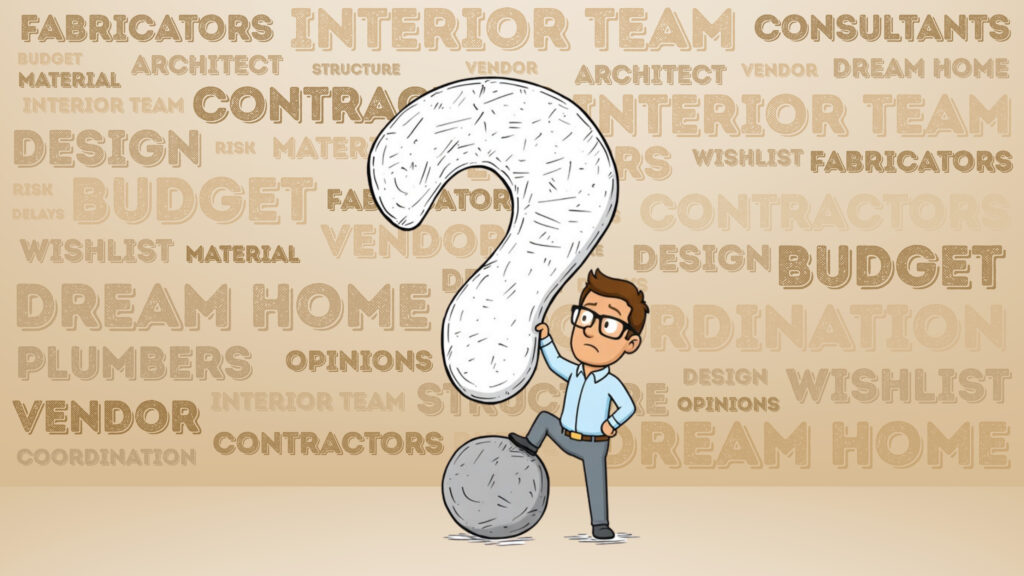
Buying land is a big milestone in anyone’s life. It’s not just about investment—it’s about finally having the freedom to build something of your own. A space that reflects your lifestyle, your taste, and your success. At this stage, everything feels exciting and full of possibilities. You already have ideas in your mind, maybe inspired from homes you’ve seen, places you’ve visited, or designs you’ve saved online.
Most people step into this journey with a clear vision. They think the process will be simple—plan the design, hire the right people, and start building. It feels like everything will move in a straight line from idea to reality.
But what actually happens is very different.
The moment you move from imagination to execution, things start getting complicated. Questions begin to come up—questions you never thought about before. And instead of moving forward with clarity, many people start feeling unsure about what the right next step even is.
This is the stage where the journey quietly shifts from inspiration to confusion, and honestly, this is something no one really prepares you for.
The First Shock: Too Many Choices, No Clear Direction
One of the biggest surprises after buying land is not cost, not construction—but the number of decisions you suddenly have to make.
You start meeting different professionals—architects, interior designers, contractors—and everyone brings their own ideas, their own approach, and their own way of working. While this sounds helpful at first, it quickly becomes overwhelming because no two opinions are the same.
Here’s what most people experience at this stage:
- Every expert suggests a different design direction
- Priorities keep changing—sometimes design, sometimes budget, sometimes practicality
- You start hearing technical terms that were never part of your original plan
- It becomes difficult to understand who is actually right
And this leads to a very real confusion.
Even if you are well-informed or have done your research, handling multiple perspectives at the same time is not easy. Instead of gaining clarity, you start second-guessing your own choices.
You may begin asking yourself:
- Am I choosing the right layout for the long term?
- Should I focus more on looks or functionality?
- What if I make a mistake that cannot be fixed later?
The biggest issue here is that no one is looking at the full picture from your perspective. Each person is focused on their own scope of work, but the responsibility of making the final decision still stays with you.
And that’s where the real pressure builds.
This phase is rarely talked about, but it’s one of the most stressful parts of the entire journey—because you are expected to make perfect decisions without having complete clarity.
The Gap Between Inspiration and Reality
At the beginning, everything feels clear because your ideas come from inspiration—beautiful homes, perfectly designed spaces, and well-curated interiors you’ve seen online or in real life. These references create a strong image in your mind of what your space should look like.
But when the actual work begins, you start realizing that inspiration and reality are not always aligned.
Designs that look perfect on screen don’t always work the same way in your space. There are multiple factors that start affecting your decisions—plot size, structure limitations, climate conditions, material availability, and even long-term maintenance. Slowly, you begin to understand that not everything you liked can actually be executed the way you imagined.
This is where the gap starts becoming visible.
You may face situations like:
- A design you loved doesn’t fit properly in your layout
- Certain materials look great but are not practical for daily use
- Some ideas exceed the budget once actual costing is done
- Changes suggested by professionals start altering your original vision
And this creates a different kind of confusion—not about choices, but about expectations.
You start feeling like you are compromising, even when you are making the right decisions. The space you imagined so clearly now feels slightly different in reality, and that difference can be hard to accept.
The biggest challenge here is not technical—it’s emotional.
Because you are not just building a structure, you are trying to bring a vision to life. And when that vision starts changing, even for valid reasons, it can feel frustrating and disappointing.
Decision Fatigue: The Silent Stress
As the project moves forward, one thing becomes very clear—there is no end to decisions.
In the beginning, you expect to make a few major choices, but in reality, you are involved in almost everything. From big elements like layout and design to small details like finishes, colors, handles, lighting, and materials—every step requires your input.
At first, it feels manageable. But over time, it starts becoming exhausting.
You are constantly thinking, comparing, and trying to make the “right” choice. And because these decisions are long-term and often expensive, the pressure increases even more.
This is what many people experience during this phase:
- Feeling mentally tired from continuous decision-making
- Spending too much time comparing options without reaching clarity
- Fear of making a wrong choice that cannot be changed later
- Delays happening because decisions are taking longer than expected
This kind of stress is not very visible, but it affects the entire experience.
Even people who are confident and well-prepared start feeling overwhelmed after a point. Not because they don’t understand things, but because the volume of decisions becomes too much to handle consistently.
And the hardest part?
There is no pause. The project keeps moving, and decisions keep coming.
This is why many people start losing the excitement they had in the beginning. What was once a dream project slowly starts feeling like a responsibility that needs to be managed carefully at every step.
Coordination Chaos: Managing Multiple Vendors
As your project moves ahead, another challenge starts becoming very real—handling multiple vendors at the same time.
At this stage, you are not just working with one or two people. There are different teams involved—civil contractors, interior teams, electricians, plumbers, fabricators, and more. Each one is responsible for their own work, but all of them need to stay aligned for the project to move smoothly.
And this is where things often start breaking down.
Because in most cases, there is no single point of coordination. Everyone is working in their own scope, on their own timeline, with their own understanding. This creates gaps in communication, and those small gaps slowly turn into bigger problems.
Here’s what people commonly face during this phase:
- Work getting delayed because one team is waiting for another to finish
- Miscommunication leading to errors or rework
- Designs not being executed exactly as planned
- Constant back-and-forth calls just to keep things moving
You may also find yourself acting as the middle person—trying to explain things from one vendor to another, making sure everyone is on the same page.
And honestly, this is not something most clients expect to handle.
Because you didn’t sign up to manage a full project. You wanted to build your space—but now you are also managing people, timelines, and coordination.
This is where the process starts feeling heavier than it should.
Not because the work is difficult, but because it is not streamlined.
Budget Confusion and Hidden Costs
One of the biggest assumptions people have at the beginning is that once the budget is planned, things will stay under control.
But in reality, budget is one of the most unpredictable parts of the entire journey.
At the start, you usually get an estimated cost based on designs and rough planning. It gives you a sense of direction, and you feel confident moving forward. But as the project progresses and details start getting finalized, the actual numbers begin to change.
And not always in small amounts.
This happens because many costs only become clear during execution. Materials, finishes, structural adjustments, and design changes—everything starts adding up step by step.
Some common situations people face include:
- Initial estimates increasing once detailed work begins
- Small upgrades or changes leading to bigger cost impacts
- Unexpected expenses coming up during execution
- Difficulty tracking where the budget is actually going
The problem is not always about overspending—it’s about lack of clarity.
Even if you have a strong budget, not having full visibility creates stress. You may start questioning decisions, delaying approvals, or constantly trying to balance between quality and cost.
And over time, this takes away the confidence you had in the beginning.
Instead of feeling in control, you start feeling uncertain about the financial side of your own project.
This is another reality that is rarely discussed—but almost everyone experiences in some form.
Time Delays and Project Drift
Almost every project starts with a timeline. There’s a rough plan, a target completion date, and a sense that everything will move step by step as expected.
But as the work begins, timelines start shifting.
At first, the delays seem small—just a few days here and there. A material hasn’t arrived, a design change needs approval, or one team is waiting for another to complete their part. These things feel manageable in the beginning, but over time, they start adding up.
And that’s when the project slowly begins to drift.
Instead of moving in a straight line, progress becomes inconsistent. Some days things move fast, and other times everything feels stuck without a clear reason.
Here’s what many people experience during this phase:
- Deadlines getting extended without a clear final date
- Work slowing down due to coordination or approval delays
- Rework causing additional time loss
- Difficulty in tracking actual progress on-site
The biggest frustration is not just the delay—it’s the uncertainty.
You start asking questions like:
- When will this actually be completed?
- Is the delay normal, or is something going wrong?
- Why does it feel like there is no fixed timeline anymore?
Even with regular follow-ups, getting a clear answer is not always easy.
And over time, this affects more than just the project—it starts affecting your personal plans, your schedule, and your peace of mind.
What was supposed to be an exciting journey now feels stretched and unpredictable.
Trust Issues: Too Many Options, No Clarity
In today’s market, options are everywhere.
You have access to multiple designers, contractors, consultants—each offering different ideas, different pricing, and different promises. On the surface, this looks like a benefit. More options should mean better choices.
But in reality, it often creates more confusion than clarity.
Because when everyone presents their own version of the “best solution,” it becomes difficult to understand what is actually right for you.
At this stage, many people start facing a different kind of challenge—trust.
You may begin to feel:
- Unsure about which professional truly understands your vision
- Confused by different pricing structures and what they actually include
- Concerned about quality, even after seeing portfolios
- Hesitant to fully commit to one team
Even after multiple meetings and discussions, there’s often a lingering doubt—“Am I making the right choice?”
And this doubt slows everything down.
You keep exploring more options, taking more opinions, comparing more proposals. But instead of getting closer to a decision, you feel stuck in a loop.
This is what we call decision paralysis.
The reality is, having too many choices without clear guidance doesn’t simplify the process—it complicates it.
And for many people, this becomes one of the most mentally exhausting parts of the entire journey.
The Emotional Toll No One Talks About
When people talk about building a home or designing a space, they usually focus on the visible parts—design, materials, budget, timelines. But what often gets ignored is the emotional side of the entire process.
Because beyond all the planning and execution, this journey quietly starts affecting your mental space.
In the beginning, there is excitement. You feel involved, motivated, and connected to every decision. But as challenges keep coming—confusion, delays, constant decisions—that excitement slowly starts turning into stress.
And it doesn’t happen all at once. It builds over time.
You may start experiencing things like:
- Feeling mentally drained even after small discussions
- Getting frustrated with repeated issues or delays
- Doubting decisions you were once confident about
- Losing interest in a process you were once excited about
What makes it harder is that this stress is not always visible to others. From the outside, everything looks like progress. But internally, it can feel overwhelming.
You are investing your time, energy, and a significant amount of money—and naturally, you want everything to be right. But the constant pressure of making the right choices and managing the process can take away the joy from the experience.
Many people don’t talk about this part.
But the truth is, building your dream space should feel fulfilling—not exhausting.
Why Even Well-Informed Clients Struggle
There is a common belief that these problems happen only when someone lacks knowledge or experience.
But in reality, even well-informed clients go through the same challenges.
In fact, sometimes they feel it even more.
Because when you understand the importance of design, materials, and execution, you also become more aware of the risks involved. You know that small mistakes can lead to long-term issues, and that makes every decision feel even more critical.
But the real issue is not knowledge.
It’s the complexity of the process itself.
No matter how much research you do or how many experts you consult, managing multiple aspects at once—design, execution, budgeting, coordination—requires constant attention and clarity.
And when all of this is handled separately, without a unified approach, it naturally leads to confusion.
This is why even experienced and knowledgeable clients face:
- Difficulty in aligning different teams and ideas
- Challenges in maintaining consistency from start to finish
- Stress from handling too many responsibilities at once
The problem is not capability.
The problem is that the process is fragmented.
And when there is no single direction or accountability, even the most prepared individuals can feel overwhelmed trying to manage everything together.
The Turning Point: What Actually Solves This
After going through all these challenges, most people come to one realization—the problem is not the design, not the budget, and not even the people involved.
The real problem is the lack of a clear, unified approach.
When everything is handled separately—design, execution, coordination, budgeting—it creates gaps. And those gaps are exactly where confusion, delays, and stress begin to grow.
This is where the turning point comes in.
The process becomes smoother when there is:
- A single team handling everything from start to finish
- One clear vision that stays consistent throughout the project
- Proper coordination between design and execution
- Clear budgeting with better control and transparency
- A system where responsibility is not divided, but owned
Instead of managing multiple people and trying to connect everything yourself, the entire project starts working as one flow.
Decisions become easier because they are guided.
Execution becomes smoother because everyone is aligned.
And most importantly, you start feeling in control again—without having to handle everything on your own.
This is what changes the experience completely.
Not more options. Not more opinions.
Just the right structure, the right planning, and the right team handling it together.
Conclusion
Building your dream space is supposed to be one of the most rewarding experiences of your life.
It starts with excitement, inspiration, and a clear vision. But as we’ve seen, the journey can quickly become complicated when too many decisions, too many people, and too many uncertainties come into the picture.
The confusion, the delays, the pressure—it’s not something unusual. It’s something most people go through, even if no one openly talks about it.
But the good part is—
It doesn’t have to be this way.
When the process is handled with clarity, proper planning, and the right approach, everything changes. The same journey that once felt overwhelming can become structured, smooth, and even enjoyable again.
Because in the end, it’s not just about building a space.
It’s about creating something that feels right—without losing your peace of mind in the process.
And when that balance is achieved, the journey comes full circle—
From confusion… back to clarity.